Transfluent Apartment
Project realised in collaboration with an architectural designer
Bespoke designed and manufactured built-in furniture
Project overview
This Budapest apartment project was realised through the reinterpretation of an existing space, where bespoke furniture was not treated as an addition, but as an integral part of the interior concept. The kitchen, entrance storage, guest bathroom cabinet, slatted partition, and bed structure were all developed within a unified system, where function, material, and detailing operate in close alignment.
The project required a high level of sensitivity. The constraints of an older apartment, the intersection of multiple trades, and a tight construction schedule were all present simultaneously. Production began in parallel with construction, requiring the furniture to be not only precise, but adaptable. The result is not a collection of individual elements, but a coordinated intervention in which furniture becomes an active component of the spatial and visual order.
Key Considerations
Interpreting the Design Intent
A primary task throughout the project was not simply execution, but a precise understanding of the architectural concept. Proportions, divisions, material choices, and detailing were developed through continuous dialogue, ensuring that each element would appear not as an isolated object, but as a direct continuation of the design intent.
Collaboration Across Trades
The realisation required close coordination between multiple disciplines. Metalworkers, security door manufacturers, and other contractors worked in parallel, aligning structural, technical, and aesthetic requirements into a single coherent system. A key value of the project lies in this coordination — ensuring that independently produced elements could meet with precision on site.
Production Drawings as a Shared Language
Detailed production drawings supported not only fabrication, but also communication across trades. Their role extended beyond traditional workshop documentation, becoming a shared reference that reduced uncertainty and supported informed on-site decisions.
Material Strategy in Exposed Conditions
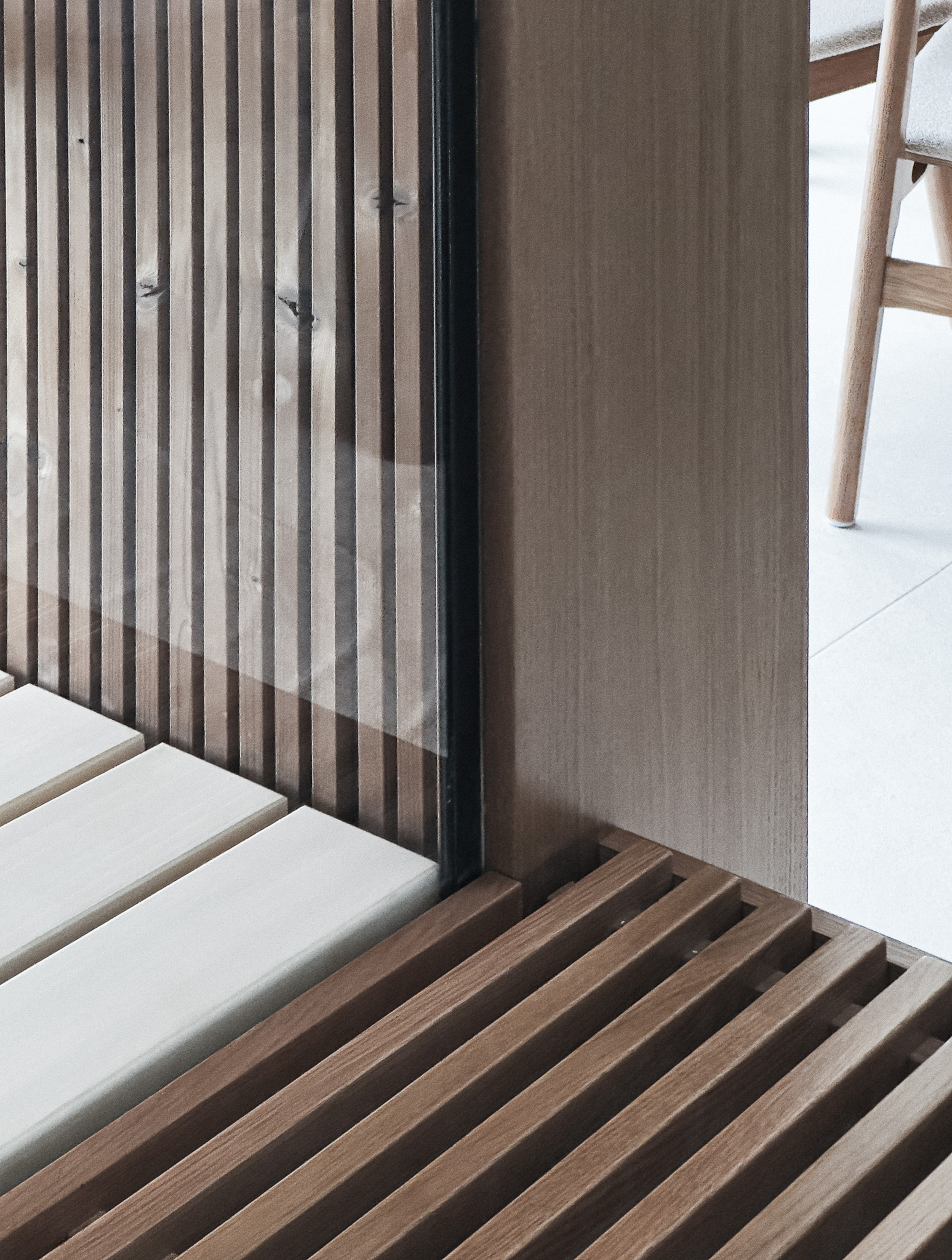
Areas subject to increased stress — particularly the sauna and moisture-exposed surfaces — required careful material selection and structural consideration. Beyond aesthetics, wood behaviour, humidity, temperature fluctuation, and long-term performance were all taken into account. Joinery, finishes, and materials were selected accordingly to ensure durability and consistent performance.
Assembly and Site Tolerance
Working within an older building required accommodating real-world deviations. Walls, floors, and adjacent works introduced variations that the furniture needed to absorb. Assembly was therefore not treated as a secondary consideration, but as an integral layer of the design — ensuring adaptability without compromising the overall precision.
Constructive Details as Design Elements
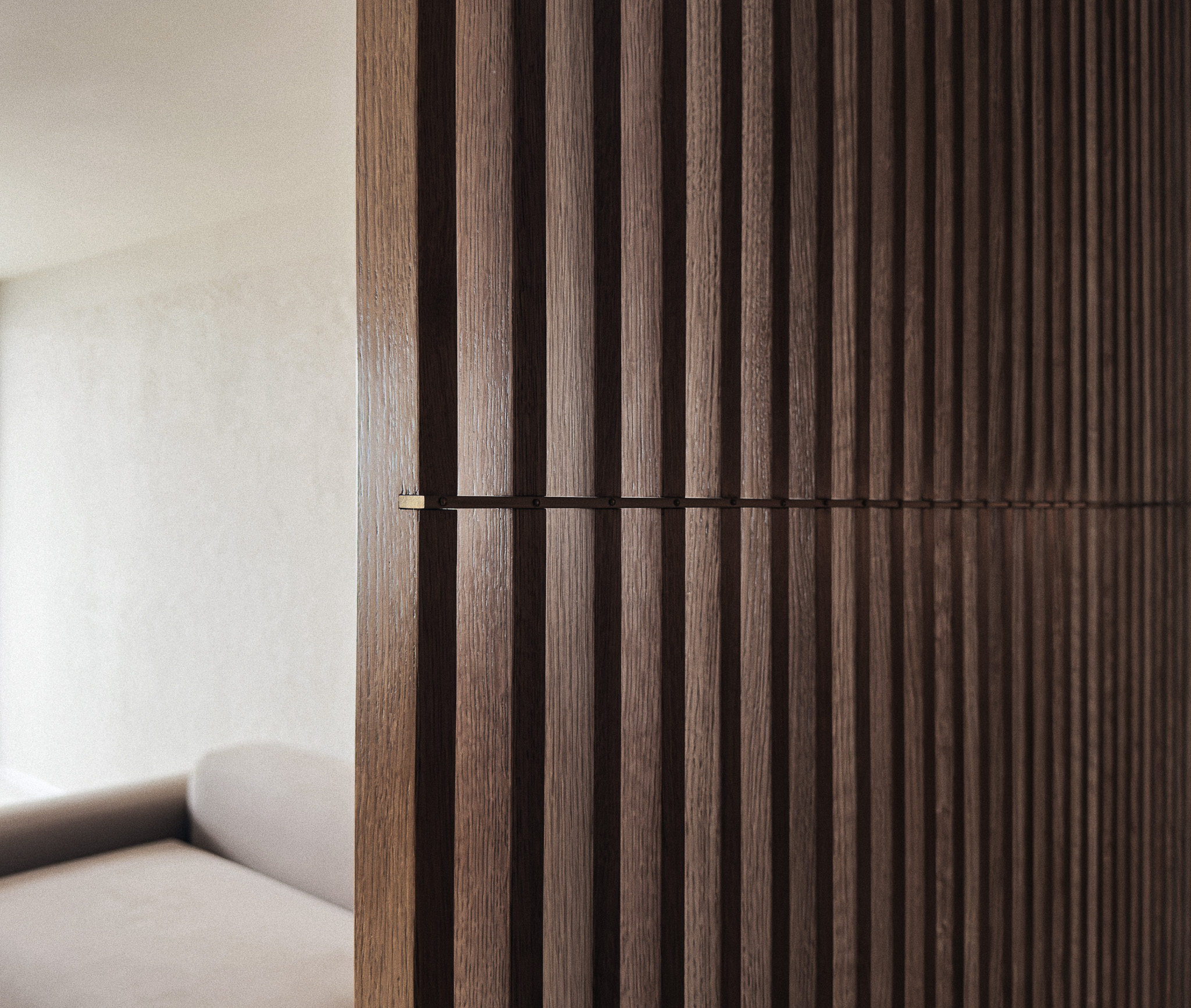
The brass inserts within the slatted partition wall reflect a broader design approach, where technical necessity becomes visible value. These elements respond to the natural movement of wood, while also enriching the visual character. Structure and appearance are not separated, but resolved within the same gesture.
Material and Finish Coordination
Close coordination between manufacturers was required to align materials and finishes. In collaboration with the security door manufacturer and their carpentry partner, decisions regarding wood species and surface treatments were carefully adjusted to ensure a consistent overall atmosphere.
Complex Structural Integration
The bed structure required precise coordination between designer, metalworker, and joinery elements produced in separate workshops. Such situations demand not only accuracy, but foresight — identifying critical junctions early and preparing them during fabrication.
Prefabrication in a Variable Context
Due to tight deadlines, parts of the production had to begin based on estimated dimensions. This required disciplined planning, ensuring that elements could adapt later with minimal intervention. The system was developed to accommodate refinement without compromising proportion or integrity.
Furniture as a Spatial Agent
The elements within the project — kitchen, entrance storage, bathroom cabinet, partition, and bed — operate not as isolated functions, but in dialogue with each other. Their proportions, alignments, materials, and details establish a shared order. The intention is not only to serve the space, but to subtly structure and define it.